
Quantum computing is no longer a distant theory—it’s advancing rapidly, and with it comes a new wave of security concerns. If you’re here, you’re likely trying to understand how emerging technologies could disrupt today’s encryption standards and what that means for your data, devices, and digital privacy. This article directly addresses that search by breaking down the reality behind quantum encryption threats, separating speculation from credible risk.
We examine how quantum machines challenge classical cryptographic systems, which industries are most exposed, and what protective strategies are already in development. You’ll also gain clarity on practical steps individuals and organizations can take now to stay ahead of potential vulnerabilities.
Our insights are grounded in ongoing analysis of core technology frameworks, AI advancements, and quantum computing research, drawing from peer-reviewed studies, security reports, and real-world implementation trends. By the end, you’ll have a clear, informed perspective on what’s at risk—and what isn’t—so you can make confident decisions in a rapidly evolving digital landscape.
The Quantum Paradox: Security’s Next Frontier or Its Greatest Threat?
Quantum computing promises unbreakable security, yet it may dismantle the cryptographic systems that guard banks, hospitals, and governments. Proponents argue Quantum Key Distribution (QKD) solves this with physics-based guarantees. Critics counter that real-world deployments expose messy hardware flaws, side-channel leaks, and infrastructure costs. Both may be right.
We still don’t understand how quantum encryption threats will evolve at scale. Standards remain fluid, and long-term resilience is debated. The science is elegant; the implementation is not. Before investing, weigh complexity, interoperability gaps, and uncertain returns. The future is powerful—but not predictable.
The Foundational Threat: How Quantum Algorithms Dismantle Modern Cryptography
First, let’s unpack Shor’s Algorithm in plain English. Today’s encryption systems like RSA and ECC rely on a simple idea: multiplying two huge prime numbers is easy, but factoring the result back into those primes is practically impossible for classical computers. Shor’s Algorithm changes that. A sufficiently powerful quantum computer uses quantum bits, or qubits (units that can represent 0 and 1 simultaneously), to explore many factor possibilities at once. Instead of guessing one key at a time, it narrows the answer through interference patterns, dramatically reducing the time needed to crack 2048-bit keys (a common security standard).
However, the danger isn’t only future tense. The “harvest now, decrypt later” strategy means attackers can capture encrypted emails, financial records, or state secrets today and store them. Once quantum hardware matures, that archived data becomes readable. This is why experts warn about quantum encryption threats even before Q-Day arrives.
Consequently, the impact spans banking transactions, government communications, software updates signed with digital signatures, and even blockchain wallets that depend on asymmetric cryptography (public-private key systems). Some argue quantum machines are decades away, so migration can wait. Yet cryptographic transitions historically take years, sometimes decades, across global infrastructure.
So what is Q-Day? It’s the point when a quantum computer reliably breaks 2048-bit RSA. Estimates vary widely, and skepticism is healthy (after all, hype cycles happen). Still, preparing now with post-quantum cryptography standards is far safer than scrambling later. Act early to reduce risk.
Implementation Risks: The Frailty of Quantum Key Distribution (QKD) Systems
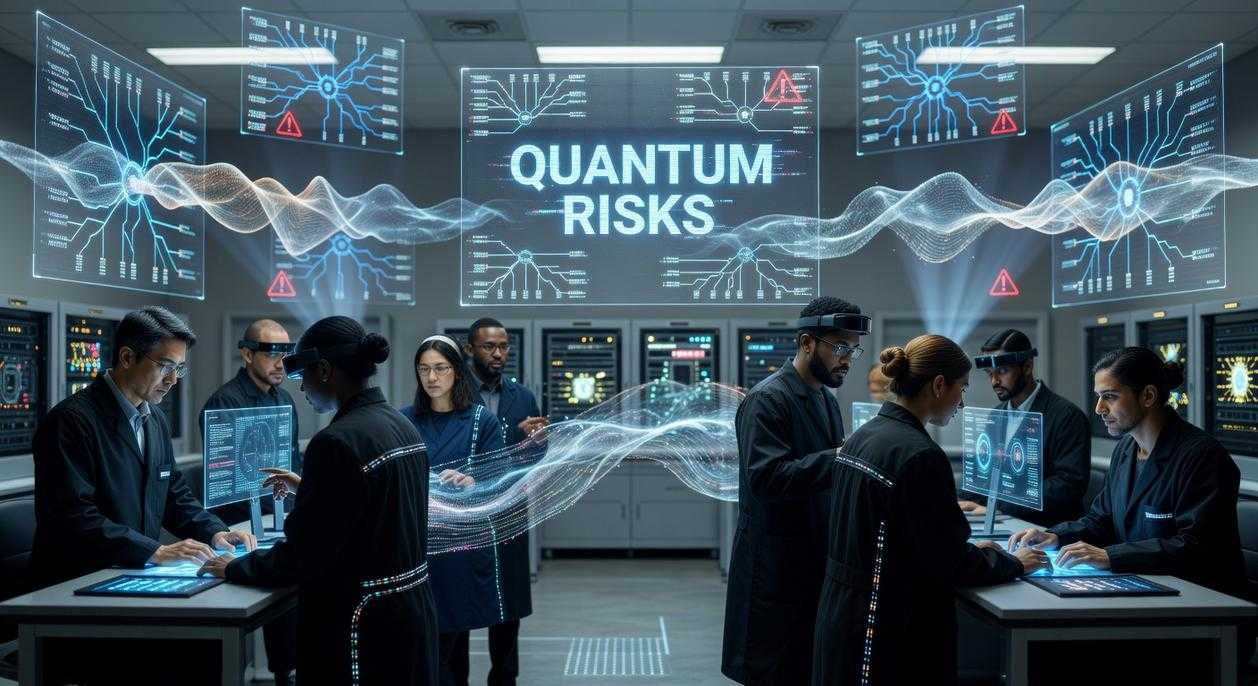
I still remember the first time I watched a QKD demo fail because someone bumped the optical table. The theory was elegant. The hardware? Not so much. That moment crystallized a hard truth: real-world systems are messy.
Hardware Imperfections
In theory, QKD (Quantum Key Distribution, a method of sharing encryption keys using quantum states of light) is provably secure. In practice, devices leak. For instance, photon number splitting attacks exploit multi-photon pulses—when a source emits more than one photon instead of a perfect single photon. An attacker can siphon one photon off without disturbing the rest. Similarly, detector blinding attacks use bright light to force single-photon detectors into classical behavior, effectively overriding their quantum safeguards. I’ve seen lab setups where tiny calibration errors opened doors wide enough for sophisticated intrusions.
The “Trusted Node” Problem
Then there’s the issue of distance. Because quantum states cannot be copied (thanks to the no-cloning theorem), long-haul QKD networks rely on trusted nodes—intermediate stations that decrypt and re-encrypt keys. Each node becomes a high-value target. It’s like passing a secret note through a chain of couriers; every handoff is a risk. Critics argue this undermines QKD’s promise of end-to-end security—and they have a point.
Denial-of-Service (DoS) Vulnerabilities
Moreover, quantum channels are extremely sensitive. Environmental noise, fiber bending, or deliberate interference can disrupt communication. A simple DoS attack doesn’t need to steal data; it just needs to overwhelm fragile optics.
The Man-in-the-Middle Challenge
While QKD detects eavesdropping, sophisticated attackers may compromise authentication layers before key exchange begins. That’s why discussions about quantum encryption threats increasingly point toward hybrid strategies, including post quantum cryptography preparing for the next security era. In other words, physics alone isn’t a silver bullet.
Economic and Infrastructural Hurdles: The High Cost of Quantum Security
Quantum encryption promises near-unbreakable protection, but at what price? Deploying specialized photon detectors, quantum light sources, and ultra-low-loss fiber networks requires staggering capital. Have you ever wondered why only governments and tech giants pilot large-scale QKD (Quantum Key Distribution, a method for securely sharing encryption keys using quantum physics) networks? The answer is simple: infrastructure costs can run into the tens of millions (MIT Technology Review).
Meanwhile, smaller firms face a harsh reality. If quantum keys must travel through dedicated fiber lines, who pays to install them? And if the hardware demands cryogenic cooling and precise calibration, who maintains it? Consequently, a quantum divide begins to form. Well-funded institutions gain premium protection against quantum encryption threats, while startups and local agencies rely on classical systems that may become obsolete.
However, cost is not the only hurdle. Today’s proprietary platforms often cannot communicate, slowing efforts toward a global, interoperable network (ETSI reports ongoing standardization gaps). Add to that a shortage of trained quantum engineers, and adoption bottlenecks grow. So ask yourself: is the world ready for secure quantum infrastructure, or are we building a two-tiered digital future?
Beyond QKD: Why PQC Changes the Game
Post-Quantum Cryptography (PQC) refers to algorithms designed to run on classical computers yet resist attacks from future quantum machines. Unlike QKD, it requires no exotic hardware. However, its core math—lattices, hash-based signatures, multivariate equations—remains comparatively untested. RSA endured decades of scrutiny; PQC has not. That gap creates real risk: subtle classical breaks or novel quantum shortcuts. Performance is another blind spot competitors gloss over. Many schemes demand larger keys, heavier computation, and more bandwidth—painful for IoT sensors or embedded chips. Preparing for quantum encryption threats means auditing performance budgets now, not after deployment.
Quantum encryption risks are no longer lab curiosities discussed in Cambridge or Shenzhen research parks; they are boardroom issues for banks in New York and telecom operators managing 5G backbones. These quantum encryption threats expose hardware supply chains, fiber infrastructure, and capital budgets.
Migration is not a firmware patch. It is a SYSTEM-WIDE overhaul touching HSMs, TLS stacks, and compliance frameworks like NIST 800-208 (which defines migration guidance).
Some argue QKD alone solves it. Others back PQC standards. Reality? A hybrid, crypto-agile model.
Next steps:
• INVENTORY every certificate, key, and dependency.
• Build crypto-agility into procurement and DevSecOps pipelines.
As we delve into the potential of quantum computers to break modern encryption, it’s essential to consider the implications for software reliability, much like the challenges faced with the Python error Oxzep7, which highlights the often-overlooked vulnerabilities in our current technological frameworks – for more details, check out our Python Error Oxzep7 Software.
Stay Ahead of the Encryption Curve
You came here to understand how emerging technologies are reshaping digital security—and what that means for your data, devices, and future readiness. Now you have a clearer picture of how AI acceleration and evolving quantum encryption threats are challenging traditional protection models.
The reality is this: encryption standards that feel secure today may not withstand tomorrow’s breakthroughs. Waiting until vulnerabilities are exposed puts your data, systems, and privacy at serious risk. Staying informed isn’t optional anymore—it’s your first line of defense.
The next step is simple. Start evaluating your current security posture, follow developments in post-quantum cryptography, and apply proactive device hardening strategies before weaknesses are exploited.
If you want clear, expert-driven insights that break down complex tech risks into practical action steps, keep learning with us. We’re trusted by tech-savvy readers who rely on deep analysis to stay ahead of disruption. Don’t wait for threats to become breaches—explore our latest guidance now and future-proof your security strategy.