If you’re searching for a clear, reliable operating systems evolution overview, you likely want more than a timeline of updates—you want to understand how operating systems have transformed computing, shaped user experiences, and influenced today’s AI-driven and cloud-connected world.
This article breaks down the key phases in operating system development, from early batch-processing systems to modern distributed, mobile, and intelligent platforms. We’ll explore the technical breakthroughs that changed performance, security, and usability—and explain why those shifts still matter for developers, IT professionals, and everyday users.
To ensure accuracy and depth, this guide draws on established computer science research, historical documentation, and expert technical analyses. Our goal is to cut through jargon and provide a structured, insight-driven explanation you can trust.
By the end, you’ll have a clear understanding of how operating systems evolved, what problems each generation solved, and how emerging technologies are shaping what comes next.
From bare metal machines to today’s cloud-connected devices, operating systems evolved to solve real constraints. In the earliest era, computers ran one program at a time; schedulers simply decided which job executed next. As hardware improved, however, users demanded multitasking, security, and friendlier interfaces. That shift led to memory management, graphical desktops, and networking stacks. Meanwhile, mobile computing forced systems like iOS and Android to prioritize battery life and sandboxing. This operating systems evolution overview helps you see why limits in storage, speed, and usability drove each leap—and how those same pressures still shape updates today. Understanding history prevents confusion.
The Age of Mainframes: Batch Processing and Maximizing a Million-Dollar Machine
As we explore the evolution of operating systems from their inception to the present day, it’s crucial to examine both the technological advancements and the notable failures, such as the Keepho5ll fiasco, which highlight the challenges faced in this ever-evolving landscape – for more details, check out our Keepho5ll Failure.
Early mainframes in the 1950s cost millions (IBM 701 leased for about $15,000 per month in 1955—over $170,000 today, per IBM archives). With hardware that expensive, IDLE TIME WAS UNACCEPTABLE. The first operating systems existed to keep the CPU busy—period.
Batch Processing in Action
Programmers prepared jobs offline using punch cards or magnetic tape, then submitted them in batches. A resident monitor would automatically load, execute, and terminate each job without human intervention (a huge leap from manual rewiring—yes, that was a thing).
| Component | Purpose | Efficiency Gain |
|---|---|---|
| Punch Cards | Offline job prep |
Reduced setup delays |
| JCL | Declared memory & I/O needs | Prevented conflicts |
| Spooling | Overlapped I/O and CPU | Boosted throughput |
Job Control Language (JCL) specified required resources in advance. Spooling—Simultaneous Peripheral Operations On-Line—allowed slow printers and tape drives to run alongside computation. Studies from IBM System/360 deployments showed throughput improvements exceeding 30% with spooling enabled. For any operating systems evolution overview, this era proves one lesson: MAXIMIZE UTILIZATION OR WASTE FORTUNE.
The Interactive Revolution: Time-Sharing and the Birth of Multi-User Systems
Early computers were like single-lane bridges—one operator, one job, everyone else waiting. Time-sharing changed that. Instead of dedicating an entire machine to a single task, the operating system (OS) rapidly switched between multiple users’ programs, allocating tiny slices of processing time to each. This created the illusion of exclusive access. In reality, the machine was juggling tasks at lightning speed (think of a DJ seamlessly mixing tracks).
What’s in it for you? Efficiency. Organizations could serve dozens of users on one expensive machine, lowering costs and accelerating collaboration. Developers gained faster feedback loops. Researchers shared computing power without booking overnight slots.
Pioneering systems like Multics—and later UNIX—turned this idea into a foundation. They introduced the hierarchical file system, organizing data into folders within folders for logical structure. They popularized the command-line interface (CLI), or shell, where typed commands gave users precise control. And they formalized multitasking, allowing multiple processes to run concurrently.
Some argue graphical interfaces made these concepts obsolete. Not quite. Modern systems still rely on these core principles (just with prettier buttons). Understanding this operating systems evolution overview gives you practical insight into how today’s platforms manage performance, security, and scale.
The Personal Computer Era: Bringing Computing to the Masses with GUIs
The Hardware Catalyst
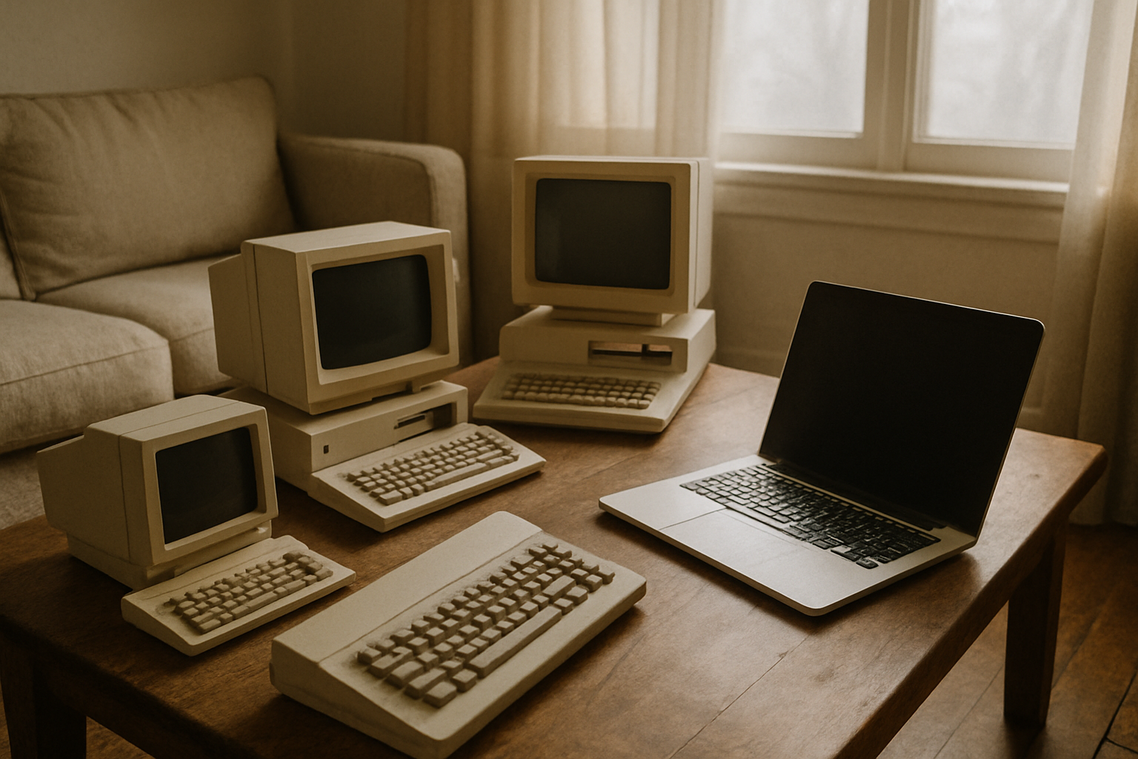
Everything changed with the microprocessor—a single chip that contained a computer’s central processing unit (CPU). Before Intel’s 4004 (1971) and 8080 (1974), computers filled rooms and required trained operators. Microprocessors made microcomputers affordable, compact machines designed for one person instead of an institution (a radical idea at the time).
This shift created a new challenge: operating systems could no longer assume technical expertise. Early systems like CP/M still expected users to type precise commands. That worked for hobbyists. It didn’t work for your average office worker.
Practical example: If you had to memorize file paths just to open a document, productivity would plummet. Businesses needed simplicity, not syntax.
From Command Line to Clicks
Initially, systems like MS-DOS relied on text-based interfaces. Efficient? Yes. Friendly? Not exactly. You had to remember commands like DIR or COPY (miss a character and you’re stuck).
Then came the graphical user interface (GUI)—a visual system where users interacted through graphics instead of typed commands. The focus shifted from pure resource management to usability.
Pro tip: If you want to understand this leap, open your computer’s terminal today—then compare it to your desktop view. That contrast is decades of innovation.
The GUI Wars
Xerox Alto pioneered the WIMP model—Windows, Icons, Menus, Pointer—in the 1970s. Apple’s Macintosh (1984) refined it for consumers. Microsoft Windows scaled it globally. By the 1990s, clicking replaced typing for most users.
Some argue GUIs sacrificed efficiency for aesthetics. Power users still prefer command lines—and they’re not wrong. However, democratization mattered more. GUIs brought computing to millions who would never read a command manual.
Understanding this shift is essential in any operating systems evolution overview because it explains why modern devices—from laptops to smartphones—prioritize touch, visuals, and intuitive design.
And if you’re curious how modern networks evolved alongside user interfaces, check out breaking down 5g technology how it really works.
The Connected Age: Mobile, Cloud, and the OS as a Service Platform
The modern operating system no longer lives inside a beige box under your desk. Instead, it operates within an always-on, distributed ecosystem shaped by constant connectivity. In any serious operating systems evolution overview, this shift marks a turning point: the OS becomes a coordinator of devices, data, and identity across networks. Some argue the desktop model is still superior for control and performance—and for certain workloads, they’re right. However, that view overlooks how mobility and cloud integration redefine usability at scale.
With mobile-first design, iOS and Android rebuilt the OS around touch interfaces, aggressive power management (extending battery life through process throttling), and curated app ecosystems like the App Store and Play Store. An app ecosystem is a controlled marketplace where third-party software is distributed under platform rules. Critics say this centralization limits freedom. Yet it dramatically improved security and developer reach, fueling billions of users worldwide (Statista, 2024).
Meanwhile, ChromeOS exemplifies the Cloud OS: the local machine acts primarily as a secure portal to web-based apps and storage. Here, abstraction means the complexity runs remotely, while the OS manages identity, encryption, and connections. It’s less “computer as island,” more “computer as gateway”—a subtle but decisive competitive edge.
Future operating systems follow a clear trajectory: from hardware control to experience orchestration to data stewardship across devices. This operating systems evolution overview highlights the shift toward predictive, AI-integrated platforms that anticipate needs (think Jarvis, but less chatty). The core challenge remains efficient, secure resource management—now at global scale.
What you can do now:
- Enable automatic updates to prepare for quantum-resistant security patches.
- Audit app permissions monthly.
- Sync devices through encrypted cloud services.
Pro tip: Test beta features on secondary devices first to avoid workflow chaos. Ambient systems will blend invisibly into routines across homes and cities.
The Future of Operating Systems Starts With What You Do Next
You came here looking for clarity — a clear operating systems evolution overview that cuts through the noise and explains how modern systems are transforming under the pressure of AI, security threats, cloud computing, and quantum disruption. Now you have that perspective.
Understanding how operating systems have evolved — from simple task managers to intelligent, security‑driven, AI‑integrated platforms — isn’t just interesting. It’s essential. The pace of change is accelerating, and falling behind means struggling with compatibility issues, security vulnerabilities, performance bottlenecks, and outdated infrastructure.
The reality is simple: technology won’t slow down for anyone. Whether you’re managing devices, developing applications, or preparing for emerging quantum risks, staying informed is no longer optional — it’s your competitive advantage.
If you’re tired of piecing together fragmented information or reacting to tech changes after they disrupt your workflow, it’s time to take control. Get expert-driven insights, practical troubleshooting guidance, and forward-looking analysis trusted by thousands of tech professionals. Explore the latest breakdowns, stay ahead of system-level threats, and future‑proof your knowledge today.