

If you’ve been searching for neural networks explained in a way that actually makes sense, you’re not alone. From AI chatbots to self-driving cars, neural networks power many of the technologies shaping our world—but most explanations either oversimplify the concepts or bury you in technical jargon.
This article is designed to bridge that gap. We’ll break down what neural networks are, how they work, and why they matter in practical, real-world terms. Whether you’re a curious beginner, a tech enthusiast, or someone exploring AI for professional reasons, you’ll gain a clear and structured understanding without needing an advanced math background.
To ensure accuracy and clarity, this guide draws on established computer science principles, current AI research, and real-world implementation examples. The goal isn’t just to define neural networks—but to help you truly understand them and see how they connect to the broader landscape of artificial intelligence and emerging technologies.
I remember staring at my phone’s face unlock feature, wondering how it recognized me after a bad haircut. At first glance, neural networks seem like a digital brain—a pattern-spotting machine inspired by ours. Yet many people argue they’re just inscrutable math, a black box we can’t truly understand. Fair point. However, when you break them down, the mystery fades.
Here’s the core process:
- Input: Data goes in (like pixels in a photo).
- Weights: Connections adjust importance.
- Output: A prediction emerges.
Over time, errors shrink through repetition. That’s neural networks explained simply—less sci-fi, more structured learning.
The Building Blocks: Deconstructing Neurons and Layers
As we delve into the fascinating world of neural networks, it’s intriguing to consider how their complex algorithms can be applied to various fields, even in the realm of gaming, like addressing performance issues in projects such as ‘Bavayllo Mods Lag‘.
Have you ever wondered how a machine makes a decision? It starts with an artificial neuron, also called a perceptron. This tiny unit takes inputs—pieces of data—multiplies them by weights that signal importance, adds a bias, and then pushes the total through an activation function. Think of it as a decision gate: if the signal crosses a threshold, it turns on; if not, it stays off. Sound familiar?
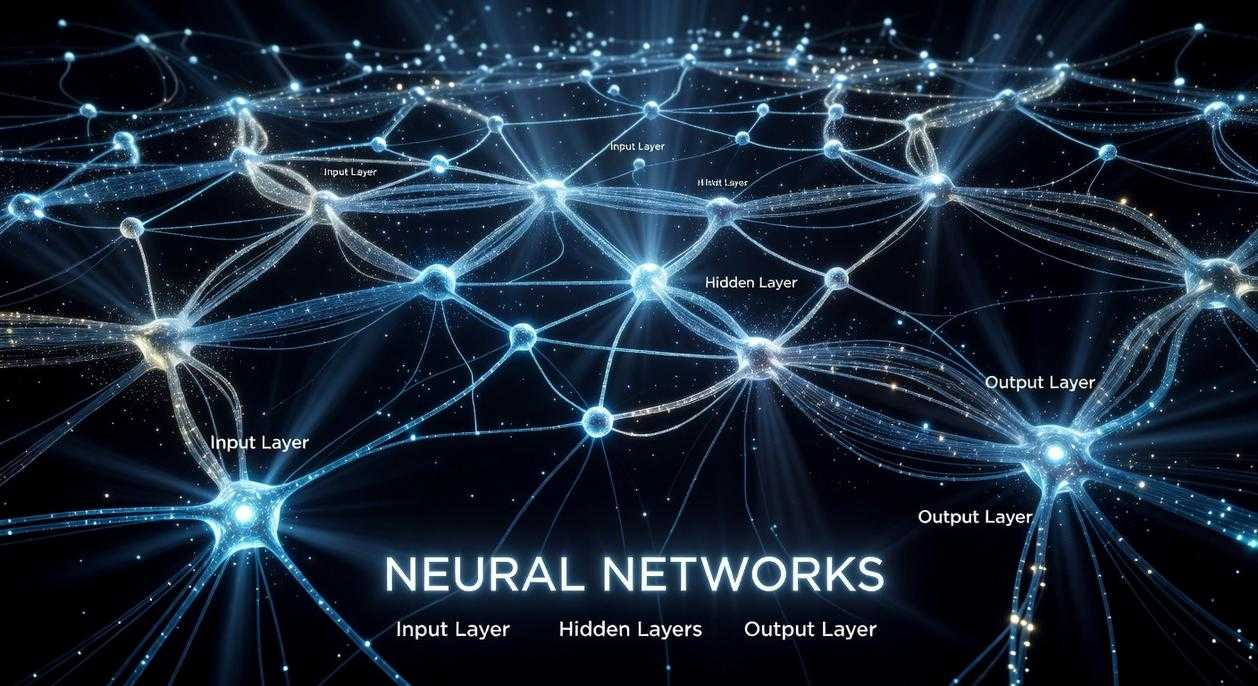
Next comes the input layer, the network’s senses. Here, raw data—like pixels in an image or words in a sentence—flows in. Without this stage, there is nothing to process.
Then, hidden layers take over. This is the thinking zone, where calculations stack on calculations. Each layer transforms the data, spotting edges in images or relationships in text. Add more layers, and the system can model more complex patterns—though critics argue deeper always means better. But is deeper always smarter?
Finally, the output layer delivers a result. It might label a photo as a cat or forecast a stock price. In short, neural networks explained in the section once exactly as it is given reveal a pipeline from sensing to deciding. So, the next time your app feels almost intuitive, ask yourself: which layer is doing the heavy lifting?
Understanding these components turns mystery into mechanism. And once you see the structure, you start to question its limits. What could you build if you rearranged the layers? That curiosity drives every breakthrough in AI. Keep exploring.
From Guesswork to Expertise: The Training Process Explained
The first time I trained a model, I remember staring at its wildly wrong predictions and thinking, “Is this thing even trying?” It felt like watching a toddler guess the answers on a math test. But that “guess” is exactly where learning begins.
Step 1: Forward Propagation
Training starts with forward propagation. This is when data flows in one direction—from the input layer, through hidden layers, to the output layer—producing an initial prediction. Think of it as the model’s first draft. In technical terms, the inputs are multiplied by weights (numerical parameters that determine importance) and shifted by biases (adjustment values), creating an output. It’s a straight shot forward—no corrections yet, just a raw guess.
Step 2: Calculating the Error (Loss Function)
Next comes the reality check: the loss function. A loss function is a mathematical formula that measures how far the prediction is from the correct answer. If the model predicts “cat” with 40% confidence when it should be 99%, the loss will be high. The entire goal of training is to minimize this error (like reducing typos in successive drafts).
Step 3: Backpropagation
Here’s where things get interesting. Backpropagation sends the error signal backward through the network. It calculates how much each individual weight and bias contributed to the mistake. Imagine reviewing a group project and pinpointing exactly who dropped the ball. This step gives precise feedback, layer by layer.
Step 4: Optimization (Gradient Descent)
Finally, gradient descent makes tiny adjustments to those weights and biases. Picture a hiker descending a foggy mountain, carefully stepping downhill to reach the lowest point—the smallest possible error. Each step is small on purpose (pro tip: too big a step can overshoot the valley entirely).
Over time, this loop—forward pass, loss calculation, backpropagation, optimization—transforms random guessing into expertise. That’s the essence of neural networks explained in practice. And if you’re curious how this powers real tools, explore the practical applications of generative ai across industries.
A Practical Example: How a Network Learns to See
Let’s make this concrete. Imagine you want a model to recognize handwritten digits from 0 to 9—like the classic MNIST dataset used in many neural networks explained in the section.
Step 1: The Input Data
Suppose we feed the system an image of a handwritten “3.” The image isn’t seen as a number at first. Instead, it’s converted into a grid of pixel values—tiny numerical representations of light and dark. For example:
- Each pixel might have a value between 0 (black) and 255 (white)
- A 28×28 image becomes 784 input numbers
In other words, the network sees math, not meaning.
Step 2: Feature Extraction in Hidden Layers
Next, the hidden layers get to work. The first hidden layer typically detects simple patterns such as:
- Edges
- Straight lines
- Basic curves
Then, subsequent layers combine these simple features into more complex shapes. For a “3,” the network may learn to recognize two stacked semi-circles. Think of it like building with LEGO bricks—small pieces first, then larger structures (yes, surprisingly elegant for pure math).
Step 3: The Final Prediction
Finally, the output layer contains 10 neurons—one for each digit. After processing, each neuron produces an activation value. The neuron representing “3” should have the highest value, making it the model’s prediction.
The Power of Iteration
Importantly, no one programs these features manually. Instead, the system trains on thousands of labeled examples, adjusting internal weights after each mistake. Over time, accuracy improves through repetition and feedback—much like practicing handwriting until it finally looks right.
The core logic of modern AI is simple: it recognizes patterns at scale. At its heart, a neural network learns by looping through four steps:
- Forward propagation, where inputs generate predictions
- Error calculation, measuring the gap
- Backpropagation, adjusting internal weights
- Optimization, fine-tuning for better accuracy
This continuous cycle steadily reduces mistakes, much like practicing free throws until muscle memory kicks in. However, some argue these systems are “black boxes.” In practice, understanding neural networks explained at a high level clarifies that data drives improvement. Moreover, this same architecture powers CNNs for images and RNNs for language, proving the principles scale.
Mastering Core Tech Concepts for a Smarter Future
You came here to make sense of complex technologies—AI, machine learning, quantum computing risks, device troubleshooting, and especially neural networks explained in a way that actually clicks. Now you have a clearer understanding of how these systems work, why they matter, and how emerging threats and innovations could impact your digital world.
The real challenge isn’t access to information—it’s cutting through confusion and misinformation. Falling behind on core tech concepts can mean missed opportunities, security risks, or costly mistakes when adopting new tools. Staying informed is no longer optional; it’s essential.
Here’s your next step: continue deepening your knowledge with expert-driven insights that break down advanced topics into practical understanding. Get reliable analysis, stay ahead of quantum and AI developments, and sharpen your troubleshooting skills with guidance trusted by thousands of tech-focused readers.
Don’t let fast-moving technology outpace you. Explore more expert insights today and take control of your tech confidence now.